


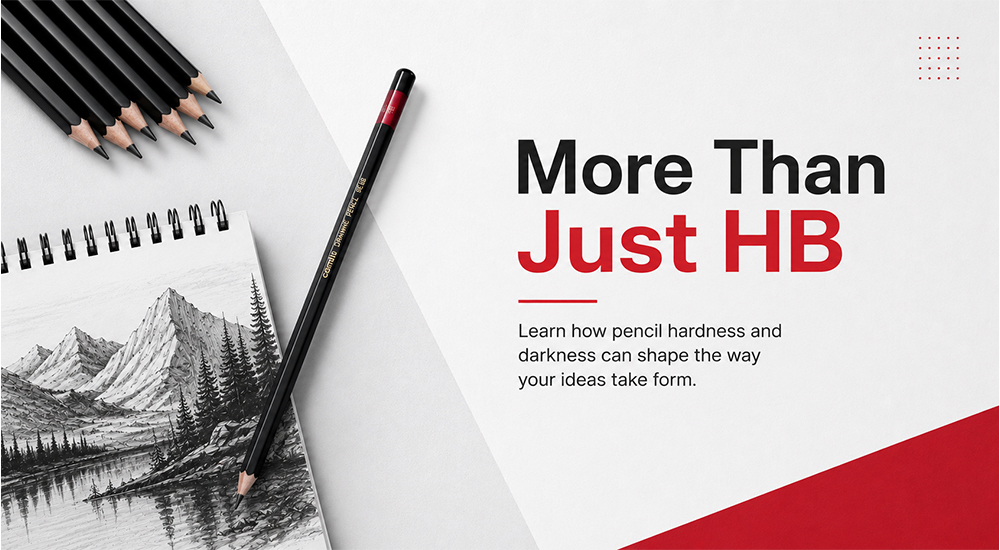
The Complete Guide to Choosing the Right Pencil Grade for Different Uses
Selecting the right pencil is not as simple as it seems. The pencil grade you pick always affects how your work looks on paper, whether it is neat writing or detailed shading. Each pencil behaves differently, so understanding a few basics can help in making a better choice. Camlin offers a wide range of graphite pencils that are suitable for everyday writing as well as drawing, which makes the selection easier.
Understanding Pencil Grades and Their Uses
Pencil grades are based on how hard or soft the graphite is, which decides how light or dark the marks appear on paper.
The letters indicate the type of graphite. H stands for hard, so these pencils make lighter and finer lines. B stands for black, which means the pencil is softer and gives darker, smoother strokes. HB is a mix of both, making it a balanced option for general use.
The numbers before the letters show the intensity. As the number increases, the effect becomes stronger. For example, higher B grades (like 2B to 10B) are softer and produce darker lines, while higher H grades (like 2H or 4H) are harder and create lighter, more precise marks.
Most Camlin drawing pencil sets include a range of these grades, which makes them useful for both simple and detailed work.
Pencil Grades for Writing and Everyday Use
For writing, a pencil should be easy to control and should not smudge too much. This is why medium grades are preferred.
- HB pencils are commonly used for daily writing
- They give clear and regular lines
- The point lasts longer compared to softer pencils
Camlin Supreme HD pencils are widely used in schools and offices because they are reliable and simple to use.
Choosing Pencil Grades for Sketching
Sketching usually starts with light lines and slowly builds into darker tones. Using more than one pencil helps in this process.
- HB works well for rough outlines
- 2B and 4B help in shaping and adding depth
- A mix of grades gives a more natural look
Camlin graphite pencil pack is useful here, as it provides multiple grades in one pack.
Pencil Grades for Shading and Blending
Shading is easier with softer pencils because they spread smoothly on paper.
- 4B to 6B are good for normal shading
- 8B and 10B create deeper, darker areas
- Softer pencils help in blending without harsh lines
Instead of pressing harder, using the right grade gives a better finish.
Use of Pencil Grades in Technical and Light Work
Some work requires clean and light lines rather than dark ones. For this, harder or balanced pencils are more suitable.
- HB pencils are helpful for diagrams and normal layouts
- They create neat lines with less smudging
- Corrections can be made easily
This makes them suitable for academic and simple technical work.
Choosing Pencil Grades Based on Paper Type
The type of paper also changes how a pencil responds.
- Smooth paper works better with HB and 2B
- Slightly rough paper suits softer pencils
- Darker grades appear stronger on textured surfaces
Using the right paper along with the pencil improves the final result.
Recommended Pencil Set for Beginners
Starting with a few basic pencils is usually enough.
- HB for writing and outlines
- 2B for little darker lines
- 4B or 6B for shading
Camlin drawing pencil sets that include these grades are a practical option for beginners.
Common Mistakes While Using Pencil Grades
A few small mistakes can affect the result:
- Using very soft pencils for writing
- Pressing too hard instead of changing the grade
- Using only one pencil for every task
- Not considering the paper type
Avoiding these helps in getting cleaner and more controlled results.
Final Thoughts
Choosing the right pencil grade mainly depends on what the work needs. A single pencil may not give the same result in every situation, so using the right grade makes the process easier and the output cleaner. It also avoids putting extra pressure on the paper, which can affect the finish.
With regular use, it becomes easier to understand which grades work better for writing, sketching, or shading. Starting with a basic set is usually enough in the beginning. A simple range like the one offered by Camlin covers most everyday needs and works well for both practice and regular use.
Frequently Asked Questions (FAQs)
Q. Which pencil grade is best for writing?
A. For writing, HB is generally considered the most suitable option. It provides a balance between light and dark marks, making the text clear without too much smudging. Among different types of pencils, HB is widely used for everyday writing, as it offers better control and consistent results.
Q. What are the different types of pencils used for drawing?
A. Different types of pencils used for drawing mainly include HB, 2B, 4B, and higher B grades. HB is used for outlines, while softer pencils like 2B and 4B help in adding depth. Darker grades such as 6B or 8B are used for shading and creating contrast.
Q. How do I choose the right pencil grade for sketching?
A. Choosing the right pencil grade for sketching depends on the level of detail and shading required. HB works well for basic outlines, while 2B and 4B are used for defining shapes. Using multiple pencil grades helps in creating smoother transitions and a more natural sketch.
Q. Why are softer pencils better for shading?
A. Softer pencils are preferred for shading because they release more graphite on paper, which makes blending easier. Grades like 4B, 6B, or 8B help in creating darker tones without pressing hard. This improves control and gives a smoother finish in shading work.
Q. What is the use of pencils with different grades?
A. The use of pencils with different grades depends on the task. Harder pencils are used for light lines and technical work, while softer ones are suitable for sketching and shading. Using the right grade helps in achieving better results without damaging the paper.
Q. Which pencil grades are suitable for beginners?
A. For beginners, a small set of pencil grades is usually enough. HB can be used for writing and outlines, while 2B and 4B are helpful for darker lines and shading. Starting with basic options makes it easier to understand the use of pencils in different situations.
Did this article help you learn something new?
Share your thoughts with us in the comments below.
Leave a comment


Comment added
Comment updated
Comment deleted
More inspiration
“
“Art is not what you see but what you make others see.”