


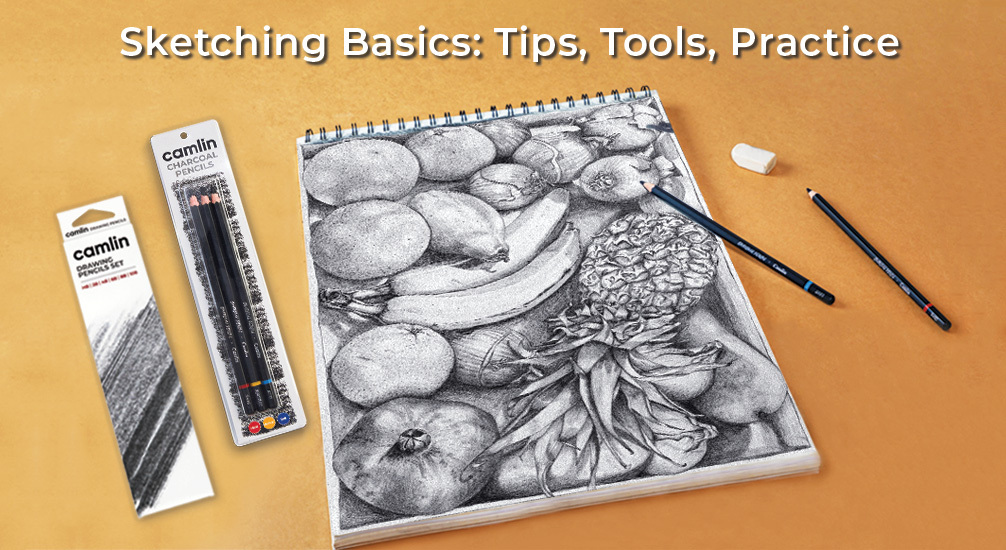
Sketching is the underdog of art. Quite literally a foundational art skill, it is often overlooked by beginners who are more focused on differentiating between different media. The good news, though, is that anyone can improve with a little guidance, consistency, and the right sketching materials. Let’s get started then.
Quick Warm-up
Before you begin, it’s best to warm up and get comfortable with your tools. Not only does a warm-up help loosen up your muscles, but it also helps you familiarise yourself with your sketching materials. A common practice is to try different mark-making techniques. It could be as simple as zig-zag lines or more complex designs such as doodles. The aim is not to make something, so don’t get hung up on perfection.
Depending on the kind of sketches you wish to draw, you can go for either a graphite-based drawing pencil or a charcoal pencil. The former are suitable for more detailed sketches, but if you want to create something that’s bolder and shade-heavy, go for the latter.
Start With Basic Shapes
Remember that one landscape drawing we all used to make as kids - triangles for mountains, a circle for the sun, and the letter V for birds. That’s pretty much what art is at the most fundamental level – every masterpiece begins with a basic shape. Drawing these shapes can help you understand the form of objects much better, so that when you look at an object, you can break it down into simpler geometric shapes that are easier to put on paper.
Keep Your Lines Light and Loose
Using a light hand on your drawing pencil while sketching is always a good practice, especially when you are a beginner. It allows you to make mistakes, subsequent adjustments and refine your work without having to wipe out everything and start again. You can work out the details once you are sure of the basic shape and form of your drawing, and you are more comfortable with how your hand flows while sketching. For light sketching, we recommend using an HB or a 2B sketching pencil, as they offer a good balance of darkness and erasability.
Focus on Proportions and Perspective
Understanding proportions and perspective helps elevate your sketches from flat representations to dynamic, three-dimensional images. This means that you know how the size of an object can help depict the distance between you and the object. E.g., objects appear smaller as they recede into the distance. So start with one-point perspective drawings and move forward as you learn.
Use Reference Photos
Sketching is often associated with real-time movements. However, it is possible to sketch using photos as a reference, especially in the beginning stage. The benefit of studying real-world objects or photos is that they allow you to meticulously understand shapes, proportions, and details without having to worry about movement. Start with simple images that have clear outlines and gradually move towards more complex scenes as your confidence grows.
Practise With Consistency
While all these methods can sound easy in theory, you should practise them consistently. Try to set aside at least half an hour for quick sketches. They don’t have to be big projects – focus on small objects like a coffee mug sitting on your table or your houseplant in full bloom. These simple subjects are excellent for honing your observation skills. The more you practise and experiment, the more you’ll evolve and find your personal style.
Conclusion
Remember that improvement takes time, patience, and a willingness to learn from every line you draw. While you take care of that, we can help you out with the right sketching materials. Get the best drawing pencils and sketchbooks and kickstart your sketching journey today!
Frequently Asked Questions (FAQs)
Q. What tools do you need to start sketching?
Ans. The only tools you need as a beginner are good-quality paper, drawing pencils (graphite or charcoal), and a kneaded eraser (that does not leave any debris after erasing).
Q. Should I sketch with HB or 2B?
Ans. Both HB and 2B pencils are good for sketching. However, if you are a beginner, you can start with HB and then move to 2B, which gives darker tones.
Q. What should I draw first as a beginner?
Ans. Once you’ve warmed up with loose lines and basic shapes, you can try out:
- Fruits
- Flowers
- Mandalas
Did this article help you learn something new?
Share your thoughts with us in the comments below.
Leave a comment


Comment added
Comment updated
Comment deleted
More inspiration
“
“Art should comfort the disturbed and disturb the comfortable.”