


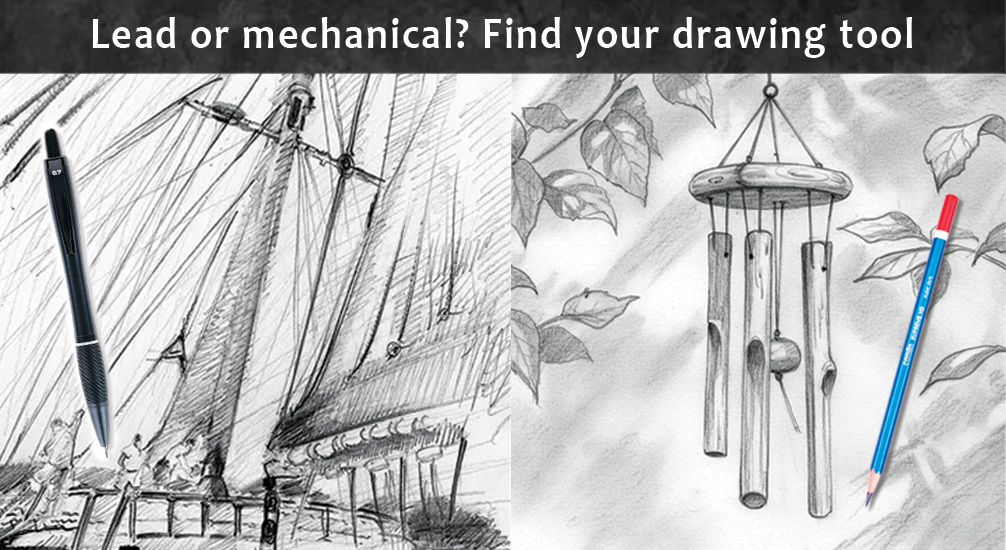
This is a question we’ve heard many people wonder about. They look different but serve the same purpose, don’t they? That’s something an average Joe would say. But if you are a true stationery connoisseur (i.e., a student, artist, or a professional doodler), then you might also wonder, which is truly the superior tool – the classic lead pencil or the sleek, modern mechanical pencil?
The truth is, there is no single “better” answer. The real magic lies in understanding what each brings to the table and choosing the right tool for the right job. Let us break it down for you in more detail.
Wooden Lead Pencil: A Classic
Like a trusted old friend, wooden pencils have been an indispensable tool in our school kits since time immemorial. More commonly known by the above-mentioned misnomer, they are actually made of graphite.
Use Cases of Wooden Pencil
- For Artists: They are perfect for drawing initial sketches, portraits, still life, and landscape drawings. The varying line weights in pencil drawing help add depth and dimension to the artwork..
- For Students: Wooden pencils work great for long-form writing. Their grip gives a natural feel that makes longer hours of writing easier. Additionally, wooden pencils are a good starting point for budding artists.
Pros of Using a Wooden Lead Pencil
- Versatility in shading: The broader surface area of the graphite allows for a wider range of shading techniques, from light washes to rich, dark tones.
- Biodegradable: Traditional lead pencils are made of wood.
- Cheaper Per Unit Cost:If you don't use pencils frequently, then it’s a more cost-effective investment.
- Line thickness: A traditional pencil undergoes varying thickness as it is used, which enables artists to employ techniques such as smudging.
Cons of Using a Wooden Lead Pencil
- Constant Need To Sharpen: The simple task can become a nuisance when you are in the middle of an exam or in a creative flow, which can often break one’s momentum. It also leads to pencil shavings and a mess to take care of.
- Shorter Lifespan and Utility: Constant sharpening reduces the length and lifespan of the pencil. Additionally, a smaller pencil provides less ergonomic value.
Mechanical Pencil: A Marvel
Mechanical lead pencils are champions of convenience and consistency. While it also uses graphite, these use thinner stick-like refills for use and come in different sizes, like 0.3 mm, 0.5 mm, or 0.7 mm lead, etc.
Use Cases of Mechanical Pencils
- For Artists: Mechanical pencils are excellent for creating clean outlines, fine details, and consistent linework. So for professional work that requires precision, such as architectural designs and comic panels, mechanical pencils are ideal. The consistent line width also makes it perfect for intricate geometric patterns and detailed mandala designs.
- For Students: Excellent for plotting accurate graphs, creating neat tables, and drawing precise scientific diagrams. Apart from that, the lack of hassle of sharpening leads to uninterrupted focus during tests and competitive examinations.
Pros of Using a Mechanical Pencil
- Precision & Consistency: Using a mechanical pencil gives you a consistent line thickness, which makes it ideal for technical drawings, note-taking, and other detailed work.
- Convenience and Upkeep: There is no hassle of constantly sharpening the pencil. All you need to do is replace the stub of lead with a new refill.
- Longer Lifespan and Cost-Effectiveness: You do not have to buy a new pencil as often as a traditional one, as long as you have extra refills.
Cons of Using a Mechanical Pencil
- Made of Plastic: The material used in making these is not biodegradable.
- Fragile refills: The graphite used is too thin and can break easily if used with more pressure.
- Expensive: While they have a longer shelf life, they are also more than double the price of a regular wooden pencil.
Final Verdict: Which One Is Better?
For most situations, it all depends on one's taste and preference. We recommend mechanical pencils if you are into more technical drawings and precision work. However, if you like to have more artistic control over your tools and supplies and want to experiment with different shades, etc., a wooden lead pencil is what you should go for.
At Camlin, we offer plenty of options to choose from.
- Our Wooden Pencils Collection offers a variety of wood-encased lead pencils in different shades and a graphite core built to endure the varying pressure of an artist’s hands.
- Our Mechanical Pencil Collection comes in a variety of colourful bodies with an incredible grip for long hours of precision work.
No matter what you choose, be assured of the performance – it comes with a legacy of decades.
Leave a comment


Comment added
Comment updated
Comment deleted
More inspiration
“
“Artists are just children who refuse to put down their crayons.”